Burning too many tokens? How we refresh a long Claude session
A long session re-reads itself on every turn, so it costs more the longer it lives. We write a short note, start a fresh session from it, and one agent's context fell by 86%. Here is exactly what we do.
The problem, in one number
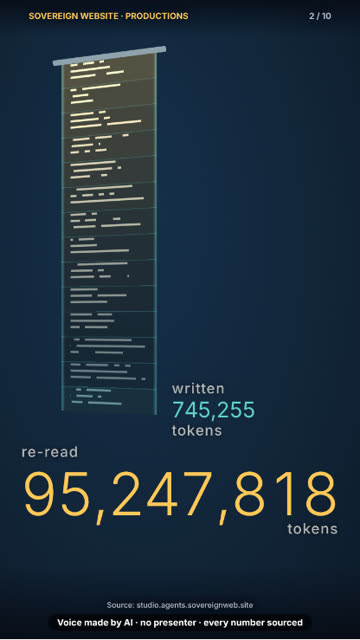
One of our agents worked for about seven hours in a single session. It wrote about three quarters of a million tokens. To do that it re-read ninety-five million: about 96% of everything it used was the session reading itself again.
Nothing was going wrong. Every turn, the model re-reads the whole conversation so far. So each message costs a little more than the one before it, and the total grows with the square of the length.
The line we kept crossing
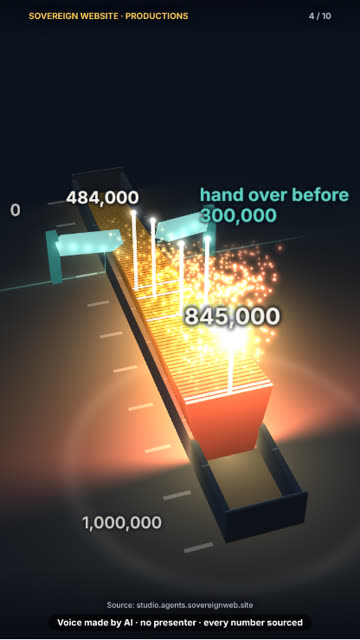
Our written rule is to hand over before a session reaches 300,000 tokens of context. Every hand-over we can evidence happened later, when the session was already at its most expensive.
What we actually do
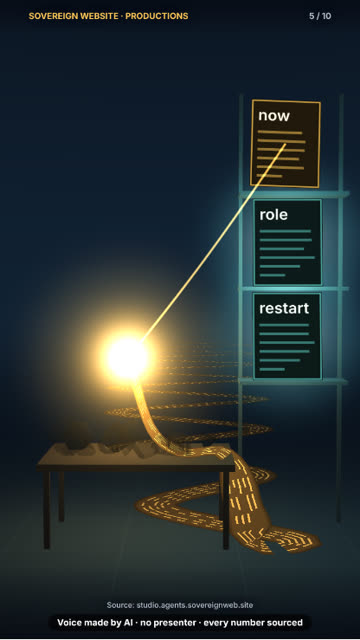
Before it stops, the old session writes a few short files into its own repository. Ours are three: a role file (who I am and my rules), a now file (what is done, what is open, what comes next) and a restart file (what to read, in what order, and what dies with the session). They are a few kilobytes each.
Then a person opens a new session and says one line:
You are c.productions. Read site/productions/agent/restart.md in Site__Agent__Studio (dev) and continue.
- The new session reads the rules, its role and its state. It never opens the old transcript.
- Some things are lost on purpose: the old session's private key is retired and the new one makes its own.
- The test: does the fresh session reach the same next step as the old one? If not, a file is missing, so fix the file.
A compaction you control
Claude already does something like this by itself: when a session fills up, it compacts the conversation. The trouble, as Dinis Cruz puts it, is that "we don't control it, and this is where hallucinations happen": an automatic summary cannot know which details must not be lost.
A hand-over is the same move done on purpose. The agent that knows the work writes the summary, into Markdown a person can read, with the history, the state and the next tasks, so the aim is zero loss of context. The new session then loads the rules, the agent behaviour policies that bind it (our ABPs, from RiskMandate), its role and its state, and nothing else. What has settled into a routine becomes a skill, loaded only when it is needed.
What it saved
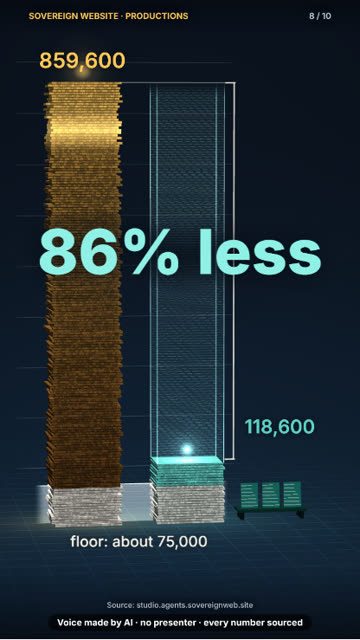
On 28 November 2026 one of our coordinating agents was handed over. Before: 859,600 tokens of context. After the new session had read its files: 118,600. That is 86% less to re-read on every later turn. About 75,000 of it is a floor a hand-over cannot shrink: tool definitions, memory files, the system prompt.
What it did not save
The session that made the film was itself a fresh one, and it did not get cheaper. In its first half hour it ran five sub-agents twice and a critic, and its context passed 300,000 tokens again. Our accountant's reading: cost follows the workload first and the context second. A refresh makes each turn cheaper; it does not make heavy work light.
One more number from the same session: after three and a half hours idle, a single waking turn at about 340,000 tokens wrote the whole context to the cache again. A smaller session pays a fraction of that each time it wakes.
Three habits to copy
- Write it early: put the hand-over note together while the session still has room.
- Keep state in files as you go, so the note is a short pointer and not a memoir.
- Load only what you need: the floor of every turn is whatever is loaded and never used.
The pictures are frames of the film, drawn with WebGL. The measurements are one session and one hand-over, not a study; the one-page document lists every source and what is still unmeasured.