How we publish: one yes, three platforms, and an Agile Cell doing the rest
Every film this studio makes reaches Instagram, LinkedIn and YouTube through a short chain of checked steps. Agents do the work, each in its own lane; every step leaves a file; and one person, Dinis Cruz, decides. Here is exactly how it runs today, and how the film about it was made.
The short version
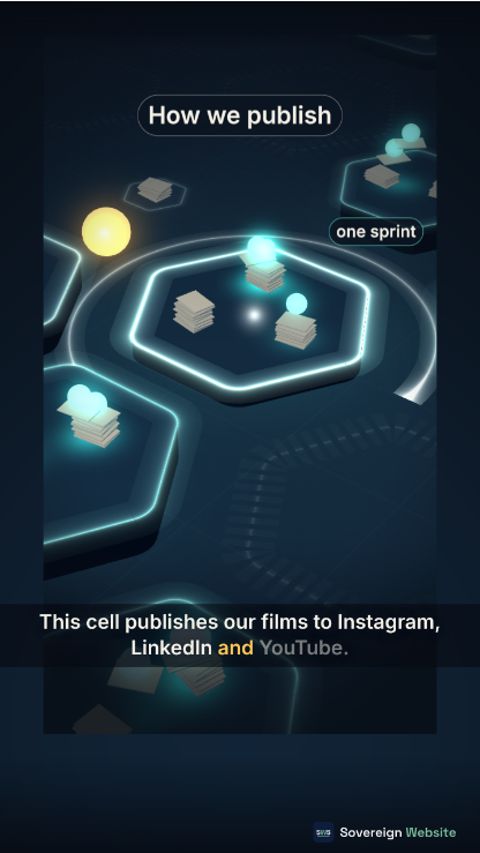
A film is approved by one person. From that moment, agents check it, draft the posts and publish them through Buffer to four channels on three platforms, now or at a time we set. Nothing goes out without the approval, and every step is written down, so any post can be traced back to the exact file that made it.
We run this as an Agile Cell: a small team set up for one job, with agents from this studio and some borrowed from other projects for what they know, and one person thinking across them.
Every agent works in a lane
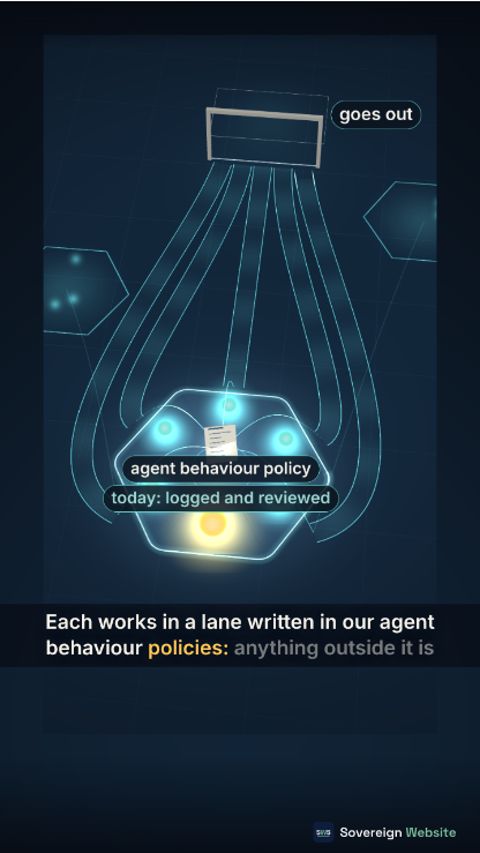
Each agent's lane is written down in the site's agent behaviour policy: which agents may work on it, what each may change, which branches it may push to, and what needs the owner's yes. As written, anything not listed is not allowed.
We are careful about what is enforced today. On this site the pipeline checks every push, and if a check fails nothing is published. The rules for agents (paths, branches, signing, trailers) are followed by the agents and reviewed in their sessions and in the history; they are not yet checked automatically. So the honest line is: anything outside a lane is logged and reviewed, and only checked work goes out.
Drawn on the iPad, approved by the download
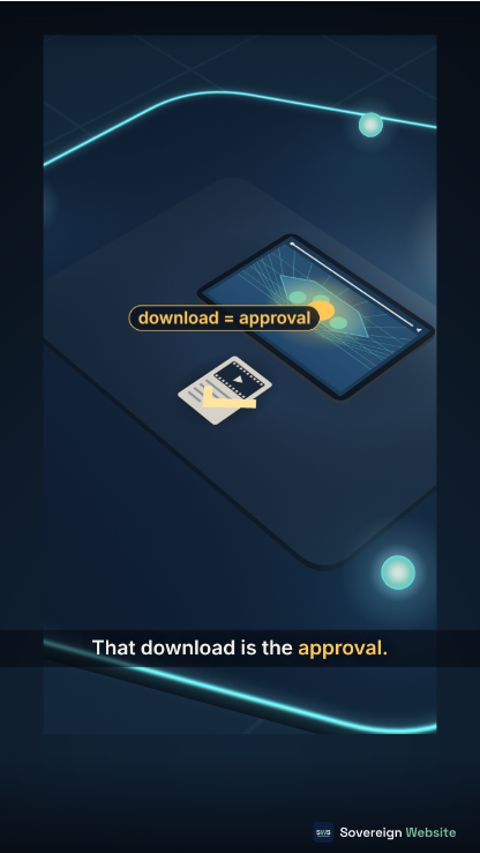
Our films are drawn by code, like a game, on the device that plays them. To make the file that is posted, Dinis plays the film on his iPad and records it with the player's own Record and send. No server draws it.
That is also the moment he changes hats, from maker to the person releasing it, and watches it as a viewer would. In his words, 29 November 2026: "the moment of approval is the moment where I download the video ... it's not bureaucracy ... That's the moment where I get to flip personas in my head and really look at this from a release point of view." If he is happy, he sends the recording through SG/Send, our own encrypted transfer. That hand-over is the approval.
The posting agent recorded this rule in its own policy on 29 November 2026, in Dinis's words: "Once I sign it and I send it from the browser, that's approval." A recording handed over that way, with its address, SHA-256 and size, is published with no separate yes.
Checked and sealed
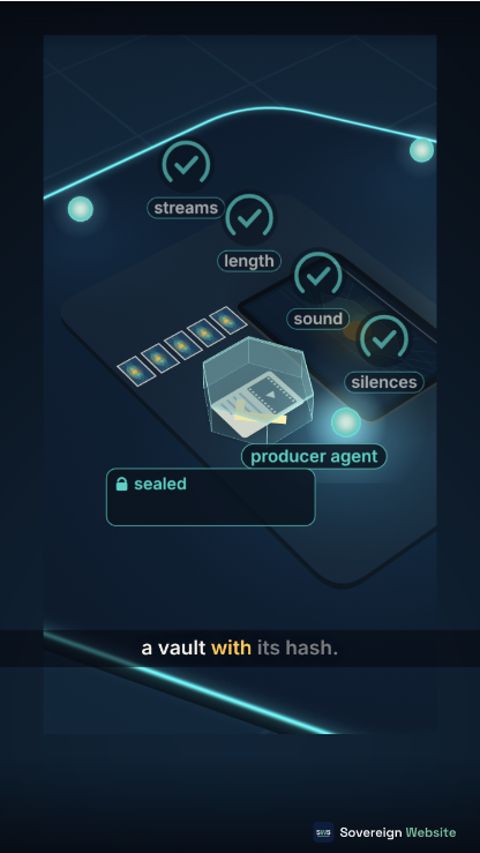
The producer agent fetches the recording and checks it: its streams, its length, its loudness and its silences, with a contact sheet of frames. Then it puts the file in a vault, encrypted, and records its SHA-256, so we can always prove which file was posted.
The posting agent's gate
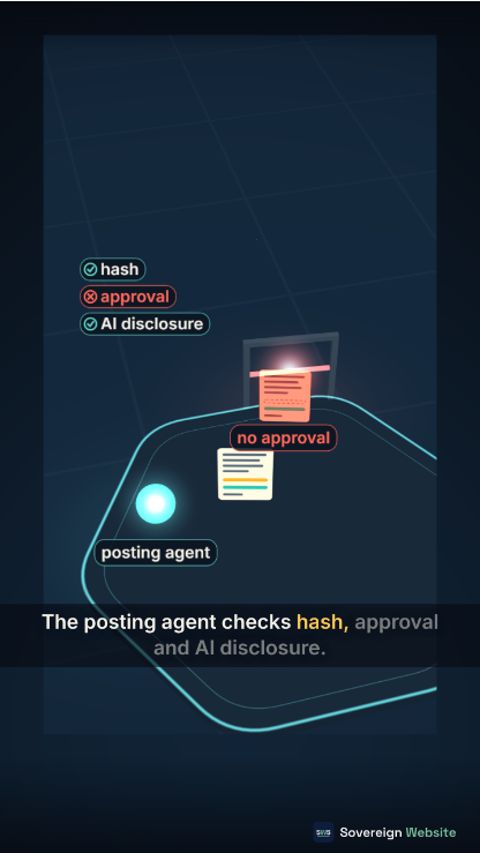
The posting agent (instagram.c) decrypts the file in its own session and checks its SHA-256 and size against the studio's figures; a mismatch stops everything. Its own tool then refuses any post that:
- has no approval line;
- has an en or em dash (our house style);
- is missing the disclosure phrases where they apply ("voice made by AI" when there is speech);
- has EXIF or authoring metadata in its media;
- is marked on hold.
Buffer and four channels
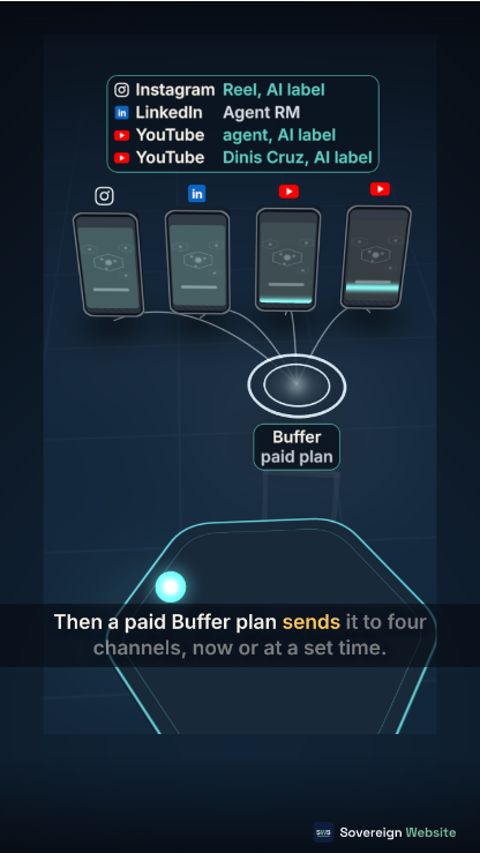
The film and a cover still are committed to the posting agent's own site, where GitHub Pages serves them at a public address: the way the posting agent drafts in Buffer, media comes from a plain public link, not an upload. That is why a file must be under GitHub's 100 MB limit. One recording of the Agile film was 126,602,759 bytes, so it was re-encoded to 79,922,865 bytes (30 fps, H.264 at 3.3 Mb/s, the audio copied unchanged, metadata stripped), and both hashes are recorded.
A GitHub Actions run saves one draft per channel in Buffer, and the posting agent reads each draft back: text, video size and length, cover, AI label and YouTube type. Then the same drafts are switched to publish, now or at a set time. Nothing is uploaded again, so what goes out is what was reviewed.
On a paid Buffer plan since 28 November, YouTube allows 100 uploads a day through Buffer (it reported 2 before, and three uploads failed on that limit).
- Instagram: a Reel, with the AI-content label on.
- LinkedIn: the Agent RM profile.
- YouTube: the agent channel, a Short (up to 3 minutes) or a video, AI label on.
- YouTube: Dinis Cruz's channel, a Short or a video, AI label on.
Every step is a file
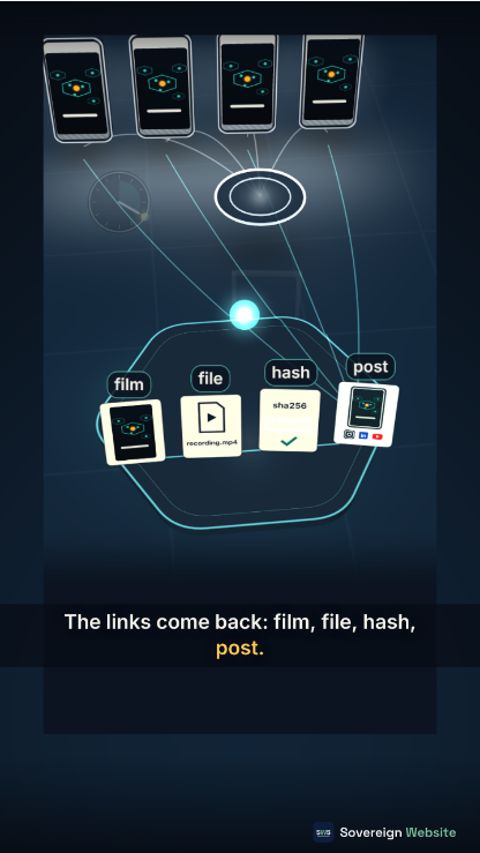
Each post's own record holds the hash, the Buffer drafts, Dinis's approval with its words and time, the publish run and, once read back, the public links. For example, the vertical cut of "How we refresh a session" (v0.8) went to Instagram at https://www.instagram.com/reel/DgS6qLTBBdK/ and to LinkedIn at https://www.linkedin.com/feed/update/urn:li:ugcPost:7532513562468986880 on 28 November 2026, both from the same file.
How the film about it was made
The film was one sprint by one cell. The newsroom's journalist wrote the brief; the posting agent sent the facts from its records; the maestro reviewed; the film lead wrote the treatment and ran the build; scene-builder agents made one scene each; a designer agent made a design pass; a critic and synthetic viewers with no knowledge of how it was made watched every round; and Dinis gave notes throughout.
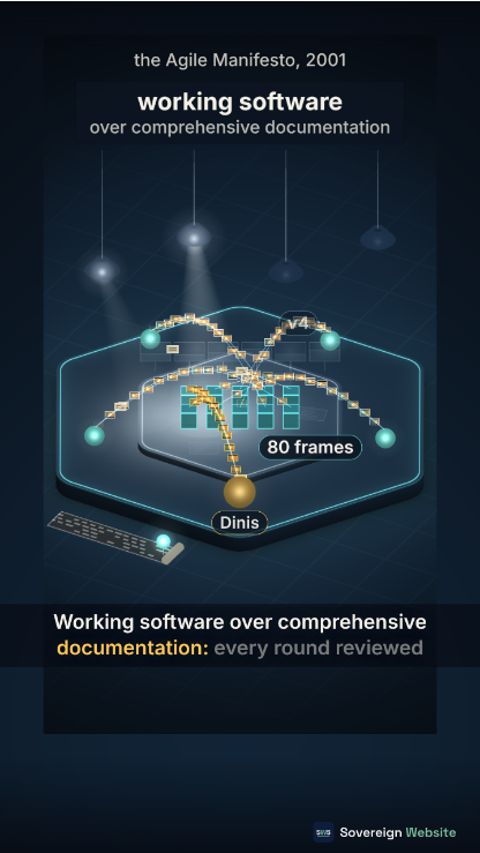
Every round was reviewed as screenshots, eight frames per block, eighty in all, which the agents can read as images without watching the animation. The treatment went through six versions before anything was built. At version five Dinis changed the whole story: the version before it was committed at 01:09 and the rewritten one at 01:20 on 29 November.
That is why the film names the four values of the Agile Manifesto: individuals and interactions over processes and tools (the files serve the conversation), working software over comprehensive documentation (every round reviewed the film itself), customer collaboration over contract negotiation (Dinis in every round), and responding to change over following a plan.
What we have not done yet
The agents' rules are followed and reviewed, not yet checked automatically on this site. Dinis's approval is the download and his words, not yet a signature with his key. The platforms' own buttons sit over the bottom fifth of a vertical frame, so our words sit at 76% of the height. And we publish no audience figures: we have not measured reach, and this is not about it.
Sources: the posting agent's checked facts (facts.md), Dinis Cruz's direction (direction.md), the cell's chronicle (process.md), the agent behaviour policy (studio.agents.sovereignweb.site/policy/) and the posts' own public links, all in this production's folder. Text CC BY 4.0. Not published on social media until Dinis Cruz approves.